Mongolian Architecture
The roots of Mongolian architecture go back to very ancient times. Ancient constructions, early complexes of men's burials, which from even from the Stone, Bronze and Early Iron Ages are met quite often in Mongolia. Stone sculptures, rock paintings, burial sepulchers are very valuable materials for studying the primordial art. For instance, graves with quadrangular barriers, dated from the IV-III centuries B.C, are widely spread over the territory of the central part of Mongolia. In the first millennium of our era a series of states emerged on the territory of the Central Asia replacing each other. The ruins of settlements, fortresses, palaces and ancient strongholds of the periods can be still found in present day. Until now about 200 such monuments have already been found on the territory of Mongolia.
The complex of the King's palace was protected with fortifications, which in their turn were surrounded with water canals and had defensive role. The remains of stupas are the sighs of buildings, which stood on both sides of the canals. The colored frescoes of a Buddhist temple, laying under the palace of Ogoodei , which was found during the exploration of Khara khorum, an ancient Mongolian capital, can also be considered as one of the monuments of the Uigur architecture.
The emergence, the rise and the decline of these cities reflect the common regularity of the development and peculiarities of the nomadic architecture.
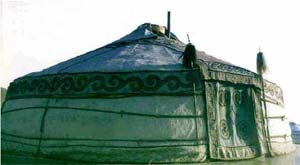 |
From the ancient times Mongolian tribes, leading nomadic way of life in the conditions of typically continental climate, were engaged in hunting and grazed their herds on rich pastures. GER, the principal and classical dwelling of Mongolians and hooded cart were well fitted for nomadic way of life. The Mongolian ger is constructed from folding lattice walls, long spoke- roofs, upper outlet- window, door, which assembled, fastened together; they are covered with felt and cloth and at last girdled with hair ropes. |
The simplest model of the ger is urts, which is still used by some people engaged in reindeer breeding. The heads are poles are fastened together, the ends are put on the earth little away from each other, and it is covered with skins and felt from the outside. For many years of their experience the similar dwellings were added with arch, walls, and doors and gradually they acquired the form of nowadays yurtas.
The interiors of the gers are of the same type. The most honorary place in the ger is the northern side, straight opposite to the door, where earlier a home altar was placed. The left side is the woman's part, the right one- men's side. Along the walls chests, caskets, beds and other articles of everyday home life were placed in semi-circle. The men's part is the place for guests: at the centre, under the arch a hearth is situated. Near to it, on the left side of the ger, we can see utensils, buckets, plates and dishes kept, and milk products, skin bag with fermented mare's milk, horse harnesses and other articles of animal uses are on the right side from stove. Round form of the ger gives an opportunity to use the space as much as possible.
The door of the Mongolian ger is always faced towards the south. The sun rays penetrating through the upper window and indicated time based on 12 month's lunar calendar. For example, at the exact mid day the sun light falls on the upper most center of the northern part of the ger. Additional vertical props-2 columns are placed to support the cupola of big gers. Sheds and tambours are made to protect from severe cold, strong wind and double door –to protect from snow storms and rains. Sometimes two gers are attached to each other. All these changes became necessary because of the settled way of life.
Nomadic tribes lived in “hurees” or in circle. Whenever the tribe moved to another place it was settled in a circle without fail. In the centre of the circle a hooded cart of an elder was fixed. A camp set up by nomads in this way had military and defensive purpose to repulse surprise attacks of enemy.
Images of “gerlugs” are often seen on rock paintings of Bronze Age. There are over 50 of them, and proceeding from them it can be assumed that “gerlugs” existed from very early times.
Wilhelm Roubrouc, a French traveler, who visited Mongolia in 1253, testifies in a book called “Travel to eastern countries”, that they put their houses on wheels, and woven switches serve as the walls of the house. The walls are joined at the top thus forming neck of the house. They are covered with white felt and the felt is often saturated with lime or bone powder to make it glitter brighter. Sometimes around the neck a black felt decorated with beautiful drawings on different themes is put. At the entrance of the house a felt covered with clothes of many bright colors is hanged up, and vines, trees birds and animals are made of colored felt.
Furthermore, W.Roubrouc writes that such dwelling is made in large forms, and the width between the wheels of a carriage is 20 feet or 6 meters. The traveler counted 22 bulls pulling one ger carriage. An iron bush from wheels of 8 to 21 centimeters in diameter was found recently during the excavations of Khara Khorum ruins and confirms these reports. W.Roubrouc also depicts another variety of carts, sheltered square carts with doors, for the transportation of which camels were harnessed.
The sizes and the carrying capacities of these carriages demanded subtle engineer intellect, because a man had to think not only of traveling distance, but also about the easiness, comfort and safety of movement while crossing mountains and rivers. The system of disposition of nomadic tribe's dwellings and stands, the form and construction of yurtas and carriages were passed on from one generation to another. It becomes clear from sources that steppe aristocracy – kings and loyal people besides ordinary gers used also in the 13 century, ger headquarters of large sizes for thousands of people.
All these gers and marquees represent by itself a simplified model, a construction of nomadic architecture verified by time. And the distinguishing feature of it was the simplicity of assembling and disassembling system. The decorations and ornaments of these gers also corresponded to the architecture itself: symbolic ornaments, allegorical images of animals were drawn in colors on silk, brocade, felt and skin. Appliques were also made on coverlets, and everybody present there enjoyed looking at them. The custom of the building gers, temples and fences using such ornaments and decorations, was continued till the beginning of the 20 century.
Towns and buildings in medieval centuries
The necessity of the significant development in economy, culture, trade, handicraft and metallurgy helped to build settlements, different in scales and in their extend of functional differentiation; stability of the state was followed by the strengthening of cities, by building frontier fortresses , with the increase in the number of settled inhabitants and improvement in agriculture.
The construction of Khara Khorum, the capital of Mongolian empire, played an important role in monumental architecture not only of the 13 century but in the whole history of the ancient Mongolian architecture. According to the information left by eye witnesses the city was surrounded by wall with 4 gates, and the distance between them was 3 miles. Various agriculture and animal goods were sold from gates. There were 12 different cult constructions in the city. All these constructions represented a whole city, an administrative capital, a gigantic town together with the Khan's palace, a military metallurgic basis, and garrisons of military forces, agricultural districts, ballast population, Bukhara and Chinese trade lines.
One of the greatest sights of them was 5 tiers Buddhist temple, built in 1256 on Munkh Khan's instruction. Its height was 300 chi /1 chi equals to 0.3 meter/ and the width is 22 meter. On the ground floor there were niches were the statues of different deities were kept. Another example is Ogoodei Khan's palace, which was square from made of 2 tier and with 8 by 8, altogether 64 columns, The entrance of the palace faced to the east; 2 tier gently sloping marquee roofs with tiles of green, red colors hung from the central axis. The roofs were decorated with sculptures and figures.
The disposition of walls, the arrangement of window opening provide large hall with illumination and ventilation. In the architectural composition of the palace the tradition of nomadic ger's structure and the planning of Kidan's constructions, i.e. the tradition of centric conception of the great steppe is noticeable.
According to the Roubrouc's description, a big silver tree, at the foot of which there were 4 silver lions, each of them has a pipe inside …. The ends of those pipes were turned down and each of them was made in the form of a golden snake's head. The tail of the snake swirled around the trunk of the tree. From the mouths of snakes 4 different drinks ran down. One was a wine, the other- a fermented mare's milk or koumiss, the third-honey, and the fourth –rice's beer. At the foot of the tree an angel made by Wilhelm stood.
On the territory of country, Mongolian Kings has several both settled and nomadic residences. Ogoodei khan had seasonal residences. Four times in a year the Khan with his retinues moved on determined route. Tsogt Taiji, an enlighther of the 17 century, an ardent fighter for the unity of the country ordered to build a castle surrounded with high walls, and fortifications. The complex of the castle was consisted of 6 temples and other constructions. The lower part of the wall was made up with stones, the upper one- with bricks, among which brick slabs with imprints of a hand, a characteristic of Kidan buildings, can be found.
The medieval cities of Mongolia are multifunctional town building formations which evolved under certain historical conditions, and they combined originally in itself the structure of nomadic and settled organization of life.
Mongolian architecture's development in 16-19 centuries
The next stage in the development of the Mongolian architecture is closely connected with the Lamaism, which was widely spread at the end of the 16 century. However, it was in the form of settled buildings. Although 17 century's town and temple buildings displayed mixed styles of the Tibetan and the Chinese, the basis of the Mongolian architecture was the structure of the nomadic ger and marquee.
The peculiarity of constructing ger and marquee became the most important sources for further development of the national architecture. In the settled way of life it was not necessary to carry or disassemble gers. Therefore, people began to erect them on special foundation. The construction of the frame of ger style building became more complicated. Various building materials began to be used for it, such as: beams and bricks. The form of it obtains round, square and many sides shapes.
The large ger style buildings, mainly temples were erected on some basis with pedestals. The outside walls consist of wooden framework. Between pedestal and wall there is another row of poles in circumference a bit higher than previous ones. 4 central columns are leaned on the square frame and fortified each other with cross beams located right under the roof itself. Later upper outlet is placed and erection takes shape of truncated one. In early times the ger consisted of spoke and frames, in summer it was covered with light materials and in winter –with felts.
Besides that one more shed tier of marquee form was erected on ger and cone shaped smooth grounds in roof. The shed was a bit smaller in size than the base, and it brought diversity into the form of religious construction. Religious constructions of the stationary type used heavy building materials and demanded new architectural solutions. The Chinese classical architecture exactly Don-Gun art of having complicated roof with console construction also exerted influence on it.
The story tells that early shamans wore white dresses and rode white horses. In the spring, the offerings to the ancestors were performed by women or else in the presence of women. Shaman costumes are inherited from previous shamans and represent a traditional garb, like a uniform.
For Mongol shamans, metal hung about their persons was essential, and some of them wore up to forty pounds of it. These material objects represent the shaman's ancestors and her spirit helpers. They wore a kaftan which closed up the back (not the sides, as is normal for an ordinary Mongol kaftan) ornamented with small pieces of metal and bells, each of which is trimmed with little strips (of cloth or leather) in snake form - which may represent a bird's feathers, ie spirit flight. The name of this formal shaman's dress is quyay, "armor" or else eriyen debel, "spotted dress". Over this is worn an apron of tapering strips about 32 inches long, hanging down from a band 8 inches wide; the color and number of the strips varies. All shamans (even those who have abandoned the rest of their ceremonial dress) wear a further apron, which is a belt of leather hung with mirrors. Altaic shamans wear nine mirrors. The mirrors are called toli and this apron has several names: the "blue cloud-bee" and also boge-yin kulug the "mount of the shaman".
Mirrors frightened evil spirits away. Further, the shaman's mirror reflects everything, inside and out - including the most secret thoughts. One shaman was quoted as saying that in his mirror, his spirit horse lives and will come when he calls. The mirror's final task is to turn away the invisible attack of evil powers, protecting the shaman. Mongol shamans sometimes wear helmets with horns. East Mongolian shamans wear silk headclothes, usually red.
The spirit drum in eastern Siberian cultures is a round drum with a crossways stick. The second form of drum has a handle with rattles inside it. Form of drums: on a round or oval iron ring, a thin goatskin is stretched when wet; the lower part of the skin has a hole through which a 7 inch handle is fitted; this is iron and runs in a ring of twisted bar-iron; the handle is wrapped with leather strips. Nine small iron rings slide along the ring of the handle, making a rattling sound. These drums are usually called "peace-drums" or "drums that welcome the New Year". The sound frightens evil demons and drives them away.
A shaman in ecstacy could do feats of strength and endurance impossible for normal men. Mongolian shamans offer forty four rituals. During the ritual shamans bacome “animated” and serve as a material support for the spirits that the shaman calls. It is noted that By 2000 in summer teachers and research people from Mongolian National University had research on shaman's ritual: singing, dancing in special costumes using drums and so on… They visited to shaman's house in north part of Mongolia and agreed to explore the rituals of shamanism. The shaman lady had the spirit of high mountain and she agreed to show them the ritual to bring the sacred mountain's snow to her house. The research team divided into 2 part to discover the ritual, so some one left outside of the ger to explore how the snow will be carried into the ger. Some people stayed inside of ger and looking at how she was dancing and singing. The most unexplainable thing is she could do, the snow was thrown through the upper window of ger into its inside, told the people, who stayed in ger. But the people left outside the ger said they did not see anything and proved nothing happened. Of course, the research team was surprised how the snow was came into the ger and where was the snow from in so summer hottest days.
Mongolian shamans were prayers to "the power of Eternal Heaven", prayers to the White Old Man (Cayan Ebugen) to the three gods in the form of armored men on horseback (Sulde Tngri, Dayicin Tngri and Gesar Khan) and to the constellation of the Great Bear (Doluyan Ebugen). Offerings of incense. Worship of fire. Worship of Mother Earth, and of the four great mountains.
In north Mongolia the fire-offering is celebrated exclusively by women on the twenty-ninth day or the last month of the year. The Fire-Mother may be the oldest version of the god of fire ...? She is the butter-faced one, who later becomes the white mother with the thunderbolt. In older prayers, the Fire-Mother is not one woman but the mothers Tala Khan, the older and younger sisters. These Fire-Maidens may number up to five sisters, wild deities with blinding white faces, upraised arms, wide-opened mouths with bared teeth. Four Fire-Maiden Tngri of the cardinal points are also spoken of: the eastern being white, the southern reddish-yellow, the western dark-red and the northern black. Prayers to the Fire Mother included requests for blessings to the umbilical cord and the womb; the birth of sons; long life, fame, riches, power; for good fortune and also protection of many kinds.
In present days most of the Mongolian Shamans are living in extreme and north part of Mongolia offering the shaman rituals to the people at their request. They are dedicating their rituals and incredible power for many things such as treatment of suffered people from any deseases, grabbing advice for fortune and so on..
Narrated by tour guides of Blue Mongolia Tour